
Sensing energy, Ayahuasca ceremonies, depth trauma work, royal vulnerability, amd therapeutic projection. Populist on subjects ranging from world domination to trauma healing Dr Gabor Maté's March 2023 interview with the banished prince at times appeared like a conversation with his own reflection.
Is insanity a spectrum, a sliding scale, on which the psyche of each one of us moves? Prince Harry, the second son of King Charles III is speaking with trauma and addiction pioneer Dr. Gabor Maté on the eve of his father’s coronation. Topics covered include plant medicine, traumatic grief, racism, ancestral dysfunction, energy healing, and the need for new kinds of compassionate community.
The themes of connection, authenticity, freedom, love, and service repeat throughout the conversation. These are five healing Nondual Qualities that have alchemized Prince Harry from being an object of perception - the toy of the media, the establishment, and TikTok gossip, into a dimension of essential agency where he is the author of his own destiny, a man of honor, husband and father. You can recognize the power of these qualities of true nature, because Harry doesn’t need to defend himself. His demeanor is gentle. He is open, vulnerable, honest, and yet free from the traps of bitterness, entitlement, aggression and pain. He is clearly tangibly loved in his new life in a way that enables him to flower.
Yet even as the two speak, the rumblings of coordinated media attack can be felt cooking in the brooding whiplash. Shock, horror, spoilt Prince Harry claims the king traumatized him. Angels weep where fools fear to tread.

August 31st, 1997, 12-year old Harry is awakened at the break of dawn by his father and told that his young, beautiful and courageous mother is dead. “It will be alright,” says Charles. He briefly touches the young boy’s knee and leaves the room. The child remains unguarded, alone, perhaps in a void of endless absence, suspended in an at once an unreal and yet ruthlessly real space of indigestible shock.
Lack of warmth, connection and emotional permission are just some of the limitations in the royal family structure that come forward in the conversation. But just as the subject of family dysfunction and childhood trauma comes forward, so does the spirit of service and the joy of doing good for others which so much characterized Princess Diana. The process of letting the legacy of true nature inform the healing of the legacy of brokenness is on display, nurture, explains Harry by his work with a therapist.

“I don’t know whether I would have been as aware of it had I not done the therapy ad the work that I’ve done... It gives us as parents more agency to be able to bring our kids up in a way that is really beneficial for them.”
From a spiritual point of view, Harry’s descent from the royal family is a story from rags to riches, from spiritual destitution to the realization of his essential nature - of a depth of value that can never be lost.
The prince is quick to acknowledges his privileged childhood.
“I had an incredible childhood, as far as I can remember, elements of it, and elements of it that were more painful” he says, but stops as he notices Gabor sadly shaking his head. “you’re about to tell me that...” he says.
“I’m shaking my head here,” says Gabor, “because when I read your book it was a story of deprivation. I don’t mean deprivation on a physical level. On a physical level you’re a scion of one of the richest families in the world with a little bit of power and privilege, but if I think of a child that was born into a marriage where there was a lack of love between the parents; where there is conflict; where there is - again, this is multigenerational, we’re not blaming anyone - but where there is infidelity; where there is a father who clearly loves his kids but can’t help but be emotionally distant because that’s how he was raised; where the father himself (this is Charles) was bullied mercilessly as a kid; where people are not held and hugged. You know, animals hug their kids... When I think from that point of view, it’s a story of deprivation. And it’s not because people didn’t love you. It’s because they were limited themselves in their ability to respond emotionally.”
Mate predictably then plunges into a diagnosis of Harry of ADHD and projects his own attachment wounds, telling the oft-repeated story of his brief separation from his mother at the outbreak of WW2 in Hungary. Harry shuffles, containing the projection. In moments, you see the loneliness of the statesman in him.
“We only know what we know,” responds Harry, “And for myself and my wife, we do the best we can as parents and learning from our own pasts and then overlapping those mistakes perhaps, and being able to grow together in order to be able to provide for our kids, and to be able to break that cycle. I think that’s so important. It’s not easy, and you certainly don’t make friends in the process in the short term.”

Maté explains how the death of a parent, divorce, and conflict in the family are big “T” traumas, and lack of being touched, held and understood are little “t” traumas.
“To experience what my girlfriend and then wife experienced in the UK was pretty shocking,” shares Harry. “I was surprised. I was quite naïve. The pain it causes to an individual is huge and the pain that it causes to society is also huge. It’s immense. I’ve made my own mistakes which I acknowledge and in a weird way I’m grateful for those experiences because I had to take accountability for it. I had to grow from it, I had to learn from it. Because I didn’t know it before. I didn’t know that I had this unconscious bias inside of me,”

“I enjoy being vulnerable because I know that it’s going to help other people... I get a huge amount of healing by helping others. It’s a theme in my life. But we have to be compassionate toward ourselves in order to be able to help others, otherwise in some cases you can end up passing on the inner toxicity to other people which is not a good place to be. Self compassion is the first thing that drops away when life becomes hard.”
“That’s true,” answers Gabor, “and self-compassion is the first casualty of trauma. My mother gives me to a stranger, and I think it’s because I must not be worthy. That’s the wound.”
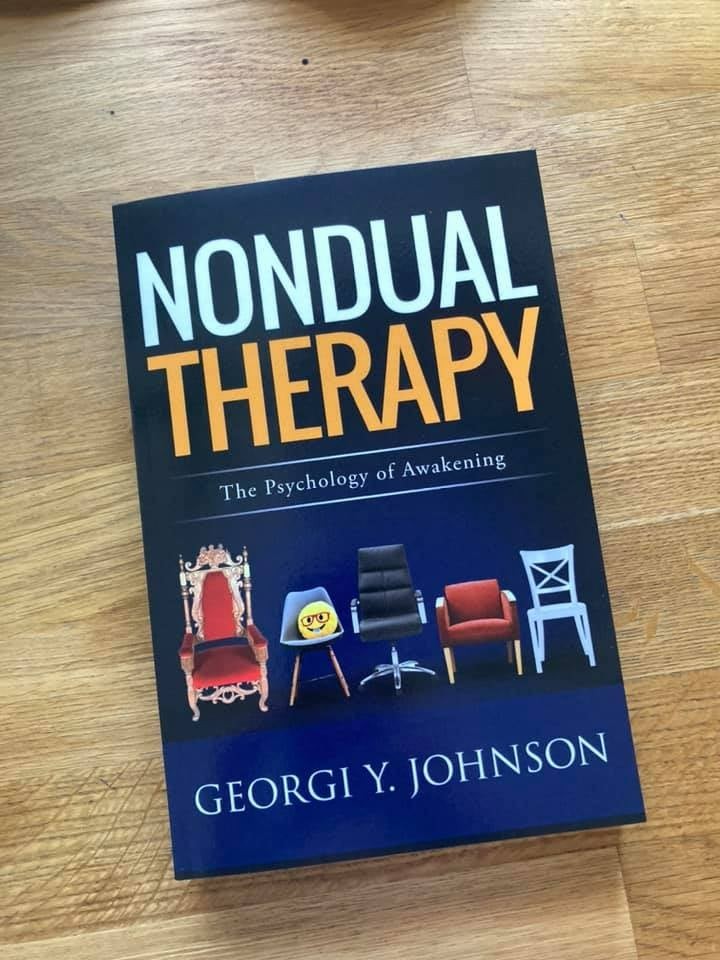
A viewer asks if grief and joy can co-exist. In Nondual Therapy, Grief is the partner of preservation and Joy is the Nondual Quality involved in the process of contraction. That is to say, the energy of grief is frozen joy, just as the energy of preservation is frozen joy. In the conversation that follows, there comes a beautiful extrapolation of how this has been experienced in the life of Harry and the traumatic loss of his mother, and in Gabor in the trauma of childhood abandonment.
“Once we start suppressing our emotions, we lose everything,” says Gabor, “So we also lose our capacity for joy. So it’s absolutely true that the more you feel the emotions of grief, the more your capacity for joy will return, and when you come with the capacity to feel the one, you come with the capacity to feel the other.”

“The grieving process is essential,” adds Harry, “And we’re not encouraged to do it. Yet in parts of Africa, I’ve experienced grieving processes where literally for two, three days families will literally roll around in the sand around a campfire and just purge, let it all out. And I think the more we can not judge ourselves by what society thinks or expects of us, the more we can grieve which is a very natural experience, the more joy we will probably end up feeling.
Yet grief does dance with the authentic need to preserve and honor the life that has been. Harry depicts this dance of grief of preservation within the joy of authentic connection:
“As I said earlier, there is an element of grief in me from losing my mum at such a young age that I almost want to hold onto, but I’ve been able to turn that into a positive as opposed to the grief that was just like a crushing weight.”
What will it take to eliminate the stigma of mental illness? Asks one watcher.
“More conversation,” says Harry. “Less of: ‘Us and Them’. I think we’re all on the spectrum, and I think we slide up and down depending on what is happening in our life. And I think the sooner we all accept that we are all on the spectrum and we all have our own stuff to deal with, The labeling is not helpful except to give a sense of what I’m dealing with, but then it has to go back to “What happened to you?” as opposed to “What is wrong with you?” The more people share, in your own environment, but also leaders and public figures, the more we can all just acknowledge this and have conversations about it, and know that the people who push back and fight against it, that is probably based on their own fear.”
Communities will come forward to meet this need for connection, sharing and healing, says Harry.
What has been the most important quality in the healing of trauma and movement toward fulfillment in the life of Prince Harry?
“Love,” he says. This love, it becomes clear in the ensuing conversation, is the wind within the process of unfolding and enfolding consciousness. It’s an energetic dynamic, not a decision of the mind. Our children pick up where we are suffering, even if we try to hide it, points out Gabor.
“That’s the thing, the invisible part of it,” replies Harry. “Your kids pick up on your energy more than you will ever know. If you ask me about energy, seven, eight, ten years ago...” (he waves his hand in dismissal) “But when I had my first child, I realized what was going on, and it is all about energy.”
Listening to the interview, it’s possible to feel the warm, affirming wind through the heart of the late Princess Diana alive between Harry’s words. He answers questions, but takes care to repeat the name and greet the one that asked. He is gentle, authentic, wise, having risen from the ashes of dissent, vilification and depressed, inconsistent and decaying royal protocol into a new purpose - a different way of being - you could say, a new way to be for real. This deeper way is one of personal integrity. It involves taking self-doubt and turning it to service, reaching out and doing good, touching people in their hearts. Soveriegnty and Service.
"Narcissism is the partner of sycophancy.
Sovereignty has no opposite.
In Sovereignty, Sycophancy and Narcissism are one."


Stay connected with news and updates!
Join our mailing list to receive the latest news and updates from our team.
Don't worry, your information will not be shared.
We hate SPAM. We will never sell your information, for any reason.